
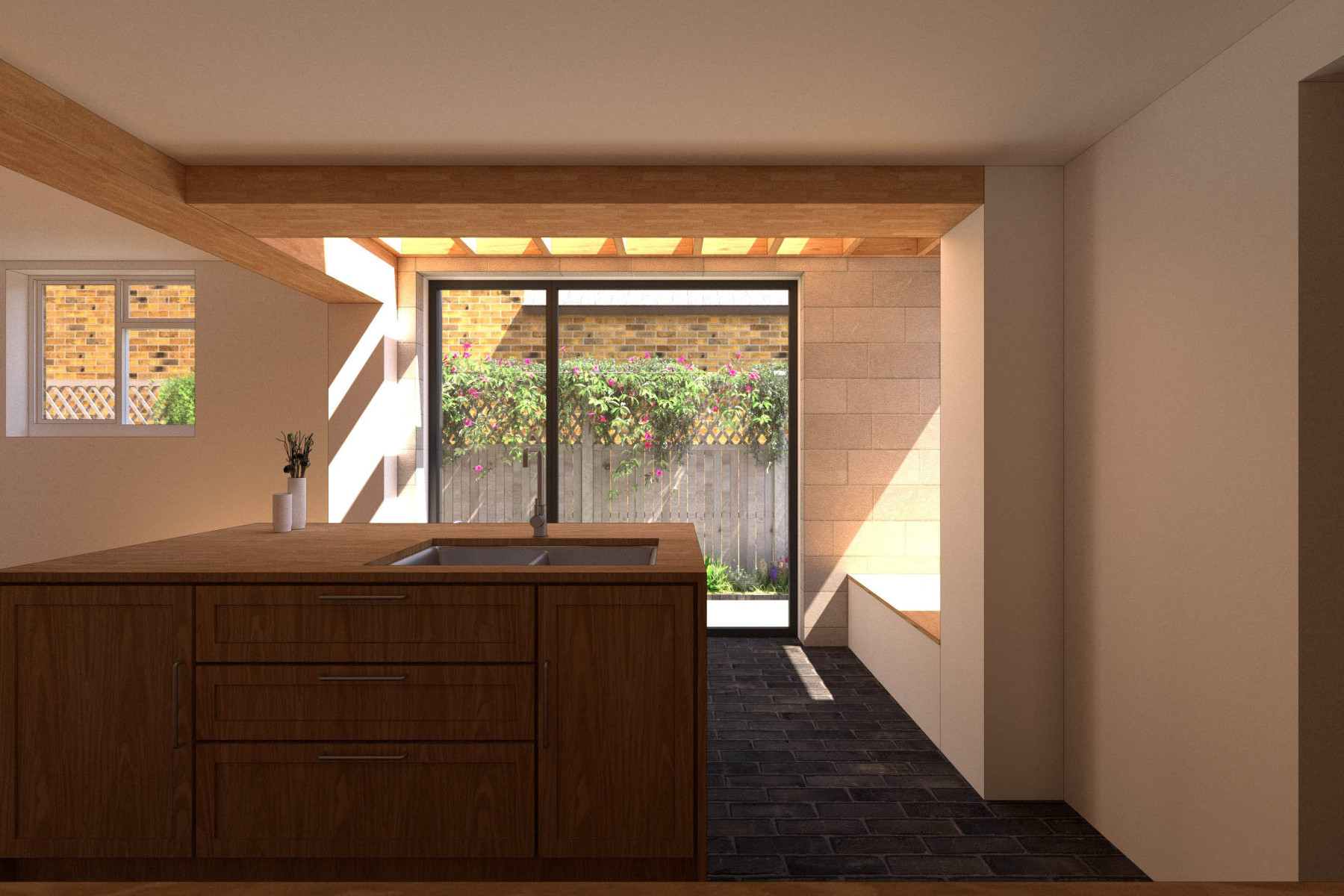
The Window That Became a Place
In our own home, we introduced bifold windows in place of fixed glazing. Not because bifold windows are fashionable, but because we wanted the wall to have the capacity to dissolve. What interested us more though, was what happened at the wall itself.
We built window seats into the reveals, low, wide enough to sit or lay across, flush with the cill. The dining table draws up to one. At mealtimes, people sit on both sides of the glass simultaneously: inside at the table, outside on the patio. A conversation at a meal becomes a conversation across a threshold.
In summer, children jump from the cill to the garden. It takes perhaps a second. But in that second, the architecture briefly disappears, what remains is just the act of crossing. We did not design the jump. We designed the possibility of it.
This is what we mean when we say that thresholds should be inhabitable. Not dissolved. Not hidden. Made into a place.
What We Have Always Been Asking
When we look back at our work, at residential extensions, at community projects, at public installations, we notice the same question recurring across every scale.
How do people take ownership of a space? What does the boundary between belonging and not-belonging actually feel like?
These are not questions that arrive from theory. They arrive from looking carefully at how people actually occupy building, not how architects imagine they will, but how they do. Children find the cill before they find the sofa. People stand in doorways rather than commit to entering. The most charged moments of social life happen at edges: the threshold of a party, the step outside a cafe, the pavement in front of a front door.
Architecture that ignores these moments in favour of the room itself misses where life is most potent.
A Square in Basildon
In early 2024, we collaborated with Basildon Council and Anglia Ruskin University on This Is Our Space, a one-day design and build event in East Square, Basildon town centre, as part of the Creative Tech Festival 2024. Working with architecture students and local schoolchildren, we built a temporary installation from recycled cardboard.
The structure was, by any material standard, humble. February wind and rain made sure of that. But what happened inside it, and around it, and in the act of making it, was not humble at all.
Children who had walked past that square every day without noticing it suddenly claimed it. They argued about where walls should go. They decided which openings to leave and which to close. They built a threshold, crude, temporary, imperfect, and then stood at it, deciding whether to step through.
We learned something from that day that no completed building had yet taught us so plainly: ownership of space is not given by a building. It is constructed through the act of making, through memory of having made, through the moment of choosing where to stand.
The cardboard is gone. The square looks the same as it did. But something was practised there that matters, a way of being in public space that the children had perhaps never tried before. The installation was temporary. The understanding it produced was not.
The Way We Walk
In 2025, Laindon Voices commissioned Studio 40 to design a wayfinding and place-making installation at and around Laindon Station, a commission that grew directly from the questions *This Is Our Space* had begun to ask.
Before we designed anything, we listened.
We sat with older residents at Woodbury Court care home, surrounded by historic photographs and hand-drawn maps. We talked about the sounds of steam trains audible from miles away, the smell of coal dust, the particular quality of bridges and social clubs that no longer exist. We asked people to remember the feeling of Laindon as much as its facts. What colour was it? What did it sound like? Where did you feel safe?
At a community wellness cafe in Langdon Hills, a woman described walking across open fields to Laindon Station before nights out in London. She would change out of her wellingtons at the station, leave them on the platform, and collect them on her return, always untouched, awaiting her return. The station, for her, was not a transit point. It was a threshold. A place where one version of herself as field-walker, rural, local, paused while another, dancer, Londoner, possibility, stepped through.
That image of wellies on a platform, dancing shoes in a bag, is the most precise description of threshold architecture we have ever encountered. And it came not from a building, but from a memory.
The community told us, consistently, that Laindon today feels unsafe after dark. That the station feels neglected. That the sense of belonging they once associated with the area has eroded. But they also told us with equal force what they wanted it to feel like again. Beautiful. Magic. Home. They wanted happy colours, not dull grey.
The six themes for the lamp post banners being installed around Laindon Station, Still Wild, Look Again, Moved In, Still Here, Everyday, On The Way, are our answer to that conversation. Each one is drawn from the community's own language: the wildlife that still inhabits the margins of the town, the invitation to look at a familiar place as if for the first time, the story of people who came from elsewhere and stayed. They are not wayfinding in the conventional sense. They are thresholds, vertical, public, visible, that ask people to pause and decide what kind of place they are in.
What This Means for How We Work
Taken together, these projects, a window seat in Essex, a cardboard installation in Basildon, banners at Laindon Station, describe a consistent set of questions operating at very different scales.
We are interested in the moment before commitment. The held breath at the edge of a space. The point where the architecture has created a condition but has not yet resolved it.
We believe that the most important spatial decisions are not about rooms but about what happens between them. That the threshold is not a problem to be overcome in the journey from outside to inside, but a place worth pausing in, designing for, inhabiting.
And we believe that this applies whether the scale is a domestic window or a town centre, because the underlying question is the same. Do I belong here? Is this mine?
Good architecture, at any scale, answers yes.
---
Studio 40 is an architecture practice based in Billericay, Essex. We work across residential, community, and public realm projects. This essay reflects our evolving design philosophy and will continue to develop as our work does.